
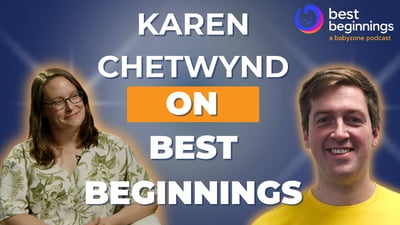
Best Beginnings Episode 28: What Karen Chetwynd told us about Montessori, freedom within limits and the childhood your child might already be having
"Montessori is not the elite nursery down the road that you can't afford. It was never trademarked. It's not a brand name. It is for everybody."
Karen Chetwynd, CEO of Montessori Global Education
Think about the last time you were trying to get a small child out of the door. They were reaching for something, perhaps choosing between the red shoe and the blue shoe. And you handed them the red one, because you were already late, because that was faster, because that was the sensible thing to do.
Karen Chetwynd would like you to consider what happened in the space between their reaching hand and your quick decision. Because in that moment, if you had the time, there was a choice being made. And in giving them the space to make it, something small and important would have developed.
This is Montessori, in a hallway, on a Tuesday morning, before school.
Not the nursery down the road
Karen Chetwynd is the CEO of Montessori Global Education, reaching over three quarters of a million children worldwide. She is also the author of Led by the Child. And the first thing she wants to make clear is what Montessori is not.
It is not the nursery down the road that you cannot afford. It is not a wooden shelf full of specialist apparatus. It was never trademarked. It is not a brand. And the moment it becomes associated only with a particular type of setting, a particular type of family, or a particular price point, a very large number of people are excluded from something that was always intended for them.
The philosophy that Maria Montessori developed, follow the child, nurture their curiosity, build independence, prepare the environment and then step back, predates much of what neuroscience now confirms about early brain development. And in that confirmation is the core argument of Karen's work: that this is not a niche educational approach. It is a description of how children actually learn. Which means that almost every parent, in some way, is already doing it.
Freedom within limits
The concept most commonly misunderstood, Karen says, is freedom within limits. She hears it described as a free for all, as a philosophy that simply lets children do whatever they want while adults watch from the sidelines. That is not what it is.
The limits are the safety considerations, the things you have already childproofed, the boundaries of what is developmentally appropriate, the cultural and social norms a child needs to learn. Within those limits, the child has freedom. And that freedom is where autonomy and independence begin to build.
In practice this looks like: letting a child choose between the red and the blue. Letting them experience the consequence of choosing the wrong one. Not tidying away the first thing they picked up before they have moved to the second. Not fixing the thing they look like they are struggling to undo. Taking the journey with them, rather than ahead of them, wherever the pace of life allows.
Karen is not romantic about the difficulty of this. Lives are chaotic. Mornings go wrong. The bus comes when it comes. But if there is a moment at the end of the day to slow back down, to follow the child's lead in some small way, it is worth finding.
Parent as first educator
The principle that has shaped Karen's practical work most directly is this: parent as first educator. And that phrase, she is careful to point out, can land very badly on a parent who has not had a positive experience of education themselves.
If the message is you are responsible for teaching your child, the weight of it can be crushing. The reframing that Montessori offers, and that Karen's work with Home Start in West Somerset sought to demonstrate in practice, is something different. It is that every parent already has the capacity. Every parent is already the best-placed person to support their child's discovery of the world. What they sometimes need is someone to stand alongside them and help them see that.
Karen describes a young mum at the start of a Home Start programme who could not yet engage with her baby without a support worker physically present in the room. Six weeks later, a natural relationship was emerging. Months later, Karen walked into a messy play session and saw this same young woman come through the door, running after her daughter, who was already ahead of her. Not a support worker in sight.
"That's all she needed," Karen says. "Somebody to help her with that."
What technology cannot replace
The conversation turns, eventually, to screens and AI and what digital life is doing to the earliest years of childhood. Karen's position is not one of alarm. She is clear that whatever children encounter on a screen, the question worth asking is what it leads to, what interaction it opens up, what curiosity it sparks, what can be explored further in the real world. Maria Montessori, she suspects, would have embraced the tools.
But there are things technology cannot deliver. Karen names three: resilience, curiosity, compassion. They cannot be transmitted through a screen. They are built through real exposure, real experience, real conflict, including, and this is the point most worth holding onto, real conflict. From a Montessori perspective, the difficult moment in the classroom is not a problem to be managed away. It is where the communication skills are built.
"Conflict," Karen says, "is not something to be shied away from."
This is what the Montessori vision of education looks like when it extends outward: a generation of people capable of dealing with difficulty, capable of disagreeing and working through it, capable of seeing, as Maria Montessori herself wrote, that we have a responsibility to each other. A community, in the truest sense.
Whether that generation starts with the red shoe or the blue shoe, the kitchen utensil pot, or a walk outside where the bugs are imaginary and the adventure is entirely real, it starts in the same place. With a child, and a grown-up who is paying attention.
Watch or listen on YouTube, Spotify, Amazon Music, Apple Podcasts and more.