
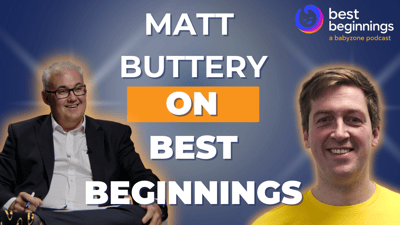
Best Beginnings Episode 26: What Matt Buttery told us about parenting, prevention and why a tenth of the money is not enough
"The best advice I've been given was not to give me advice."
Matt Buttery, CEO of Triple P
The practitioner who doesn't answer
Imagine a parent sitting across from a support worker, finally ready to ask for help. They put the question that has been building for weeks: what should I do? A good practitioner, Matt Buttery will tell you, rarely answers that question directly.
Instead, they acknowledge it, ask to understand more, and then turn it back. From everything we have looked at together, from the strategies we have covered — what do you think? What do you want to try first? How can I help you with that?
This is Triple P: the Positive Parenting Program, the world's largest evidence-based parenting programme, operating across more than 80 countries. And this counterintuitive approach - building the parent's confidence rather than solving their immediate problem - is at the heart of why it works. The goal is not compliance. It is not dependency on a service. It is the thing Triple P calls self-regulation: a parent who believes they have the skills and agency to handle the next challenge, and the one after that, without needing to call anyone.
Matt Buttery is the CEO of Triple P. He is also a parent of four, a former foster carer who supported fourteen children over ten years, and originally a biochemist who spent his career learning how to translate what the evidence says into practice. He is someone who has sat across from practitioners himself in tears, on his knees, not knowing what to do. And he is someone who has spent the years since making sure the strategies that helped him can reach as many families as possible.
A tenth of the money
There is a number at the centre of this conversation that takes a moment to absorb. At the peak of Sure Start, the UK invested approximately £2.7 billion a year in early family support. Today, the comparable investment, through family hubs, Best Start and Healthy Babies, is around £300 million. A tenth of what it was, for a problem the evidence says is more urgent than it has ever been.
This conversation was recorded during the week of the Labour Party conference, at a moment of genuine political momentum around the early years. Matt values the direction of travel. He is careful to say so. But he is also one of the most evidence-literate voices in this field, and he is direct about what the numbers mean: good intentions and a fraction of the historic resource are not the same thing as the change that is needed.
His argument is not simply that more money is required, though he believes it is. His argument is more specific: that any serious investment must be built around reach, evidence, and the delivery formats that parents actually want. Nesta's research shows that parents now overwhelmingly prefer online support. And yet the architecture being rebuilt around family hubs risks, in Matt's view, reconstructing a twenty-year-old model for a world that has fundamentally changed.
Magic fairy dust
The moment that explains why Matt Buttery does this work is not a policy paper or a clinical trial. It is a story.
More than twenty years ago, a three-year-old boy came to stay with Matt's family through foster care. He had been severely neglected. Left alone in a flat for long periods. Most of his teeth had rotted out. His behaviour, when he arrived, was described as off the scale. And there was already, in the system around him, a quiet sense that this child was a lost cause.
He was three years old.
Matt's family had recently started engaging with Triple P. They used some of the strategies with this young man, and they watched the changes come. When the boy later had supervised contact with his birth parents, the parents told Matt something he has never forgotten. You have magic fairy dust, they said. You have a magic wand. That is why he is different with you.
He hadn't. He had learned some strategies. What broke something open in Matt at that moment was the understanding that those same strategies could have been learned by that family too. Through no fault of their own, through the accumulated circumstances of their lives, they had simply never had the opportunity.
"We were similarly out of our depth," he says. "But we learned some strategies that you could also learn. You could do that stuff too."
It is that realisation, not the randomised controlled trials, not the Deloitte cost-benefit analysis, though he has both, that drives the work.
The case for going large
In Australia, Triple P's online programmes reached 700,000 families in a little over three years. No practitioners, no appointments, no waiting lists. Published studies, including a non-inferiority trial comparing online delivery to ten weeks of face-to-face support, show broadly comparable outcomes. And a recent real-world outcomes study of 2,150 families going through the programme produced results consistent with the controlled trials.
Matt is not arguing that digital replaces in-person support. He is arguing for a comprehensive model: different levels of intensity, different delivery formats, built around where people actually are and what they actually want. Because some parents need reassurance and a light touch. Others need significant, sustained support. And the families who need the most intensive help will sometimes find their way there through a gentler first step — an online programme that builds confidence and opens a door.
The 7-to-1 return on investment verified by Deloitte is one way of making this case. The boy with rotted teeth and behaviour off the scale, who changed because someone learned some strategies and applied them. That is another.
What the evidence is saying, consistently and across countries and decades, is that investing in parenting works. The question left sitting at the end of this conversation is whether the UK is building something designed to reach the families who most need it or something smaller, more cautious, and harder to find.
Watch or listen on YouTube, Spotify, Amazon Music, Apple Podcasts and more.