
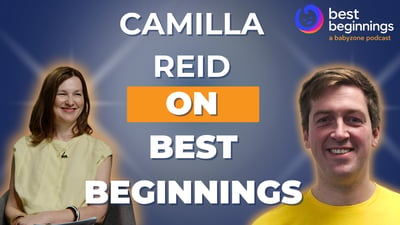
Best Beginnings Episode 18: What Camilla Reid told us about school readiness, the 1.5 million word gap and why five minutes is enough
"It's like a multi gym for the baby brain, but it's totally painless. It's just fun."
Camilla Reid, Author
Every August, there is a small but significant moment in many homes. A school uniform is tried on for the first time. A name label is ironed onto a PE kit. At open mornings, children are shown the classroom, the cloakroom, the peg with their name on it. In kitchens and living rooms across the country, families are trying to work out what, exactly, they need to do to get their child ready for September.
The answer, if you follow the national conversation, tends to point toward academic preparation. Can they hold a pencil? Do they recognise their letters? Can they count to ten? Camilla Reid, who has spent more than 30 years creating books for babies and toddlers and sold over 40 million of them around the world, thinks we have been measuring the wrong things for a long time.
What ready actually means
Reid's new book, I Am Ready for School, is structured around a deceptively simple idea. At every turn of the page, the child in the story is ready to move on to the next thing: ready for the cloakroom, ready for lunch, ready for home time. There are no alphabet drills in it. No number sequences. What there is, in some detail, is a child learning to find their peg, manage a busy room and feel capable in an unfamiliar environment.
The book grew from long conversations with Evie, the deputy head of Reid's local primary school, who has watched generations of children move through the school gates. What distinguished the ones who flourished, Evie told Reid, had little to do with whether they could read before they arrived. It had everything to do with whether they felt safe, capable and able to connect with the people around them.
"It's not really about all the formal learning stuff," Reid told George on Best Beginnings. "It's about laying a foundation of self-confidence and security so that children, when they walk into that door on the first day, they know how to handle themselves."
That is the thesis the book is built on: a small, specific toolkit of attitudes, skills and behaviours, not abstract academic knowledge but the practical, human capability to exist confidently in a new space.
The tool that does everything
The school readiness conversation is, at its core, a reading conversation. Not because children need to be literate before September, but because reading, done early and often, builds exactly the qualities that help a child thrive in a reception classroom.
Reid puts this in terms that are hard to forget. When she speaks to early years practitioners, she puts up a picture of a Swiss Army knife on screen, all its blades extended. "It's quite a violent looking image," she says, "but then I just put round the edge: this is a very useful tool." Reading, she argues, is that tool. It develops concentration, language, memory, the capacity to follow a sequence and anticipate what might come next. These are not incidental benefits. They are precisely the cognitive and social-emotional foundations children need to learn.
The key insight is that all of this happens invisibly. A child sitting with a parent and a book does not know they are developing their working memory or expanding their vocabulary. They know they want to hear the story again. "It's like a multi gym for the baby brain," Reid says, "but it's totally painless. It's just fun."
The five-minute habit
There is a statistic at the centre of this episode that stops the conversation in its tracks. A child who has been read to daily from birth to five will have heard nearly 1.5 million more words than a child who has not. Not because their family read for hours. Because someone opened a book, just for a few minutes, again and again, across thousands of ordinary days.
Reid is careful with this kind of figure. She is aware of the guilt it can produce, particularly in families where books are scarce, time is short or reading has never felt natural. Her advice is pragmatic: pick the short book. The one you can get through in three minutes. Read it at breakfast, in the high chair, after the nap, wherever the moment exists. "Grab tiny moments," she says, "and literally this is five minutes, four minutes of reading. But that is so potent for your relationship, and for the relationship they will have with books going forward."
She is also emphatic that reading does not require the ability to read words on a page. It is turning the pages. Opening the flaps. Looking at the pictures together and letting the conversation grow out of them. "I don't really mind if you don't read the words I've written," she says, "as long as you're just engaging with the child and the book together."
What the screen comparison tells us
Late in the episode, Reid raises something more urgent. Children's brains, she explains, cannot process the pace at which screens move. The speed triggers a stress response. Cortisol is released. The child becomes dysregulated rather than calm. "Screens work at a pace that children's brains cannot follow," she says. "And books don't do that."
This is not a moral argument. It is a physiological one. The case for reading, in Reid's framing, is not that screens are bad for character or attention. It is that screens produce a biological response in young children that works directly against the foundations families and early years settings are working to build: calm, connection, the capacity to focus and relate.
At a time when a large proportion of children are arriving in reception classrooms having been frequently exposed to fast-paced digital content, this matters in ways that extend well beyond individual families.
The village question
School readiness, Reid insists, is not a parenting test. "It takes a village to raise a child," she says. "We all should feel that children belong to all of us." The families BabyZone works with across its hubs navigate real complexity: financial pressure, chaotic home lives, the exhaustion of keeping everything moving. Reid is not asking them to do more. She is asking us, as a society, to do more around them.
That means school libraries as a given, not a luxury. Lending libraries in early years settings, where a child walks out with a book and returns it the following week. Small, structural changes that turn a five-minute habit into something every family can access, whatever their resources.
There is a moment near the end of the episode where George asks Reid what gives her hope. She talks about the growing honesty around screens. About a sense that we are beginning, collectively, to take children's cognitive and emotional environment more seriously.
What she does not say, but what the entire conversation implies, is that the answer has always been there on the shelf. Slightly chewed. Probably read forty times already. Still just as good.
Watch or listen on YouTube, Spotify, Amazon Music, Apple Podcasts and more.