
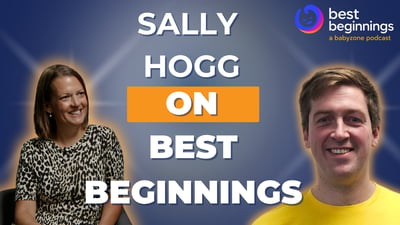
Best Beginnings Episode 17: What Sally Hogg told us about why early childhood never sticks, the 97% gap and what the new PM should do on day one
"All of the progress we make always feels so fragile. As happened with Sure Start, we can have these brilliant programmes and then they can go again."
Sally Hogg, Founding Director of Start Strong
There is a phrase that has been used so often in British politics that it has lost almost all its friction. "Early years matter." It appears in manifestos, in budget speeches, in the opening paragraphs of government strategies. Almost no one disputes it. And yet, as Sally Hogg is quick to point out, a country that truly believed early years mattered would look quite different from the one we have.
Hogg is the founding director of Start Strong, a ten-year campaign to make early childhood impossible to ignore. She has spent her career in and around this space, at the NSPCC, in government, at the Parent Infant Foundation where she founded the 1001 Days Movement, and at the Royal Foundation Centre for Early Childhood, where she helped shape the Shaping Us campaign alongside the Princess of Wales. Very few people in the UK have thought as hard or for as long about why the gap between what we say about early childhood and what we do about it keeps persisting.
The 97% problem
The data she leads with is striking. When researchers ask the British public whether early childhood matters for later life outcomes, 97% say yes. Near-universal agreement. But when the same people are asked whether government should make it a priority, the number drops. This is the salience gap, and it sits at the heart of everything Hogg is trying to change.
"Why do people think this matters but don't think it's something government should be doing about?" she asks. Part of the answer is that the public does not fully understand the scale of the problem. They assume children are broadly okay. Shining a spotlight on infant mortality statistics, on the fact that babies in the least advantaged areas are twice as likely to die in their first year as those in the most advantaged, begins to move people. So does talking about the children who arrive at school already unable to seize opportunities, and the children who are not.
The stories that don't cut through
Hogg is generous about the arguments that have been made. The brain science on early development is important and well evidenced. The economic case, showing the return on investment from early years intervention, is powerful in Treasury conversations. But neither quite does the work that needs doing at a population level.
The brain story, she explains, tells people how children develop. It does not carry a burning platform. It does not say: and there are this many children having experiences that are not developing a healthy brain. The economic case works with civil servants and chancellors. But the public, she says, "don't want the government to look after my kids so that tax revenues in the future are different. I want the government to look after my kids because they're the most important thing in my life."
Long-term arguments struggle with short-term human attention. We know this from public health campaigning. You do not stop teenagers from smoking by telling them about their lungs at 70.
The myth that costs us
There is another barrier that research keeps surfacing. When people explain why investment in early childhood is not a priority for government, a significant number reach for a particular story: feckless parents making bad choices. If that story is in the room, support for government action drops. Why would the state intervene in something that is simply the result of individual failure?
Hogg's response to this is clinical. It is very, very hard, she says, to find a parent who does not love their child or want the best for them. Parents who are not doing the things that support healthy development are almost always not doing them because they live in systems that make it much harder. Housing, poverty, parental stress, the collapse of community. These are not excuses. They are the actual context.
Shifting people from the feckless parent frame to a systemic frame, one where the question is not why these parents are failing but how we create conditions in which every parent can be the parent they want to be, is a significant part of the research Hogg is leading through Start Strong.
Why nothing sticks
Sure Start is the case study she returns to. It was brilliant, she says, and then it went. Early childhood provision keeps operating as a set of time-limited programmes sitting alongside the real infrastructure of government: a minister with a title and some money, a specific set of services for a specific period, then a cut, then a new initiative, then another cut.
What she wants, and what Start Strong is building toward, is a shift to early childhood as core public infrastructure. Not a nice extra. A given. As unthinkable to dismantle as primary schools or GP services.
Day one
When George asks what she would put on a new Prime Minister's briefing note on day one, she is specific. Start with outcomes: not services, not funding lines, but what we are doing well for our babies and children and what we are not. Make the briefing holistic: maternity, health visiting, family hubs, early education, housing. Treat it as a cross-government question, because the fragmentation of these services across departments is itself part of the problem.
She also wants babies explicitly named in a ministerial job title. Not because job titles change systems, but because a dedicated minister with a mandate to champion babies and young children across government, someone whose job it is to say "but how are our youngest children actually doing?" in every room they enter, has historically made a material difference.
The cure we already know
The thing that gives Hogg hope, after decades in this space, is not a policy announcement. It is a jolly two year old. And it is a conviction that, unlike many of the hardest problems societies face, this one is not a mystery. "We know exactly what babies and young children and families need," she says. "Things that support them to develop loving relationships. Things that support them to play and thrive."
We know what the cure is. The challenge is building the systems that deliver it, reliably, for every child, long after the headlines have moved on. That is the ten-year work she has set herself. Babyzone is part of the movement she is trying to build.
Watch or listen on YouTube, Spotify, Amazon Music, Apple Podcasts and more.