---
title: "Better Start Conference 2026: what we learned"
description: A look back at the Better Start Conference in Blackpool. Here are the key themes, speakers and takeaways we are bringing back into Babyzone.
image: https://babyzone.org.uk/hubfs/20260305_163140.jpg
---
[Matched funding live: every donation is doubled from 2-16 June.](https://donate.biggive.org/campaign/a05WS00000C7riEYAR)
[](https://babyzone.org.uk)
[](https://babyzone.org.uk)
- [About Us](https://babyzone.org.uk/about-us)
- [Our Model](https://babyzone.org.uk/our-model)
- [Our People](https://babyzone.org.uk/team)
- [Careers](https://babyzone.org.uk/careers)
- [Hubs](https://babyzone.org.uk/visit-us)
- [Volunteer](https://babyzone.org.uk/volunteer)
- [Our Programmes](https://babyzone.org.uk/programmes)
- [Partners](https://babyzone.org.uk/partners)
- [Academy](https://babyzone.org.uk/academy)
- Impact & Insights
- [Impact](https://babyzone.org.uk/research-impact)
- [Research](https://babyzone.org.uk/babyzone-research)
- News & Media
- [News](https://babyzone.org.uk/blogzone)
- [Media](https://babyzone.org.uk/media)
- [Baby Buddy](https://babyzone.org.uk/baby-buddy)
- [About](https://babyzone.org.uk/baby-buddy)
- [For Parents](https://babyzone.org.uk/babybuddy-for-parents)
- [For Local Authorities](https://babyzone.org.uk/baby-buddy-for-local-authorities)
[Donate](https://babyzone.org.uk/donate)
- [About Us](https://babyzone.org.uk/about-us)
- [Our Model](https://babyzone.org.uk/our-model)
- [Our People](https://babyzone.org.uk/team)
- [Careers](https://babyzone.org.uk/careers)
- [Hubs](https://babyzone.org.uk/visit-us)
- [Volunteer](https://babyzone.org.uk/volunteer)
- [Our Programmes](https://babyzone.org.uk/programmes)
- [Partners](https://babyzone.org.uk/partners)
- [Academy](https://babyzone.org.uk/academy)
- Impact & Insights
- [Impact](https://babyzone.org.uk/research-impact)
- [Research](https://babyzone.org.uk/babyzone-research)
- News & Media
- [News](https://babyzone.org.uk/blogzone)
- [Media](https://babyzone.org.uk/media)
- [Baby Buddy](https://babyzone.org.uk/baby-buddy)
- [About](https://babyzone.org.uk/baby-buddy)
- [For Parents](https://babyzone.org.uk/babybuddy-for-parents)
- [For Local Authorities](https://babyzone.org.uk/baby-buddy-for-local-authorities)
[Donate](https://babyzone.org.uk/donate)
[← Back](https://babyzone.org.uk/blogzone)
# Better Start Conference 2026: what we learned
[Sign Up To Our Early Years News Roundup](https://share-eu1.hsforms.com/1Vneg2jsPR5C3b2eBW289Jw2b57kc)
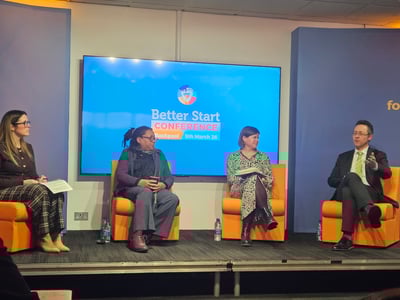
Last week, the Babyzone team attended the Better Start Conference in Blackpool. It brought together colleagues from across the UK to share what early years transformation looks like in practice.
The atmosphere was positive, generous and full of momentum. Across panels, symposia and conversations throughout the day, there was a shared focus on building systems that work for babies, young children and families, not just launching pilots.
### Panel sessions
The day centred around four panel sessions on:
- what makes place-based collaboration effective
- how we build a shared story about why the early years matter
- how to measure what really matters for children and families beyond school readiness
- what real early years transformation looks like and how we know it is happening
### Symposiums
Alongside the panels, the programme included symposium workshops focused on:
- how to move from pilots to sustainable programmes and scale what works
- using infant experiences to shape better care and family support
- local voices and co-production to drive early intervention and systems change
- measuring child development in ways that reflect what matters to families
- collaboration, power sharing and building trust with lived experience at the centre
### Speakers
Across the day, we heard from speakers including:
- **Clare Law** (CEO, Better Start) who hosted the conference
- **Chris Sherwood** (CEO, NSPCC)
- **Louise Bazalgette** (Deputy Director, A Fairer Start Mission, Nesta)
- **Neil Jack** (Chief Executive, Blackpool Council)
- **Dr Beverley Barnett Jones MBE** (Former Associate Director, Practice and Impact, Nuffield Family Justice Observatory)
- **Elaine Fulton** (Director, Common Outcomes for Children and Young People Collaborative)
- **Alison Morton** (CEO, Institute of Health Visiting)
- **Emily Sun** (CEO, Place Matters)
…and many more.
### Key themes from the day
A few messages came through again and again:
- **Be where families are.** Strong early years offers show up in the places families already use and trust, and remove barriers to participation.
- **Collaboration is the work.** Sustainable change depends on deep partnership across local authorities, health, early years settings, VCSE organisations and communities.
- **Move from pilots to learning systems.** The best work has a clear north star for outcomes, and creates feedback loops so delivery can adapt over time.
- **Measure what matters.** Data and evidence should support learning and improvement, grounded in local context and lived experience.
- **Design for equity.** Speakers emphasised the importance of naming and addressing structural inequality so early help systems are equitable and just.
### What we learned (highlights)
Drawing on the panels and symposium discussions, these were some of the most useful takeaways we are bringing back into our work:
- **From pilots to programmes:** transformation needs system-building, continuous learning and a clear set of outcomes that everyone can align behind, not just time-limited projects.
- **Evidence plus local context:** the strongest examples combined evidence-informed practice with deep understanding of local communities, co-production, and adaptation rather than “copy and paste”.
- **A stronger focus on babies:** several sessions emphasised the need to keep babies and young children visible in our language and decisions, and to centre lived experience, including parent and infant voice.
- **Early identification through partnership and data:** practical examples showed how better information-sharing, joined-up pathways, and routine monitoring can help identify needs earlier and reduce families being passed between services.
- **Trauma-informed, relational support:** discussions on parenting and infant care highlighted the importance of consistent relationships, postnatal support, and approaches that recognise trauma and stress in family life.
- **Equity by design:** speakers were clear that structural racism and inequality shape families’ experiences of services, so system change has to be intentional about fairness and access.
- **Evaluation alongside rollout:** a repeated call was to invest in evaluation and data collection as programmes scale so we learn who approaches work for, who they do not work for and why, and can improve in real time.
- **Sustained investment:** there was a strong message that long-term outcomes require long-term commitment including backing grassroots community leaders and organisations so local, culturally grounded work can be tested and scaled.
### How this connects to Babyzone
Much of what was highlighted mirrors how Babyzone hubs are designed to work: a welcoming one stop shop where families can access high-quality early years learning, play and practical support in one place, delivered alongside local partners.
We are proud that these principles are already being put into practice across Babyzone, and we are taking away a renewed focus on strengthening the evidence and learning behind our model as we continue to grow.
### Thank you
A huge thank you to the Better Start team for hosting such an excellent day, and to everyone who shared their work and experience so openly.
If you attended the conference too, we would love to hear what you are taking back into your work.
[Donate](https://babyzone.org.uk/donate)
[](https://babyzone.org.uk/)
Supporting families through early years with expert guidance, resources, and community connection. Every child deserves the best start in life.

[](https://www.fundraisingregulator.org.uk/directory/babyzone)
### Quick Links
- [About Us](https://babyzone.org.uk/about-us)
- [Our Team](https://babyzone.org.uk/team)
- [Hubs](https://babyzone.org.uk/visit-us)
- [Our Programmes](https://babyzone.org.uk/programmes)
- [Partners](https://babyzone.org.uk/partners)
- [Academy](https://babyzone.org.uk/academy)
- [Impact](https://babyzone.org.uk/research-impact)
- [Research](https://babyzone.org.uk/babyzone-research)
- [News & Media](https://babyzone.org.uk/blogzone)
- [Baby Buddy](https://babyzone.org.uk/baby-buddy-old)
### Contact Us
hello@babyzone.org.uk
Scale Space, 58 Wood Lane, London, W12 7RZ
Babyzone is a registered charity in England and Wales (1198316) and in Scotland (SC054355)
### Sign up to our newsletter here
Get the latest Early Years News Roundup delivered to your inbox
[Early Years News Roundup](https://share-eu1.hsforms.com/1Vneg2jsPR5C3b2eBW289Jw2b57kc)
[Donate](https://babyzone.org.uk/donate)
© 2026 Babyzone. All rights reserved. Making a difference in early years development.
- [Safeguarding Policy](https://babyzone.org.uk/hubfs/Babyzone%20Safeguarding%20Policy%20England%20-%20Updated%20Sept%202026%20(no%20appendix%20c).docx)
- [Privacy Policy](https://babyzone.org.uk/privacy-policy)
- [Safer Recruitment Policy](https://babyzone.org.uk/hubfs/Babyzone%20Safer%20Recruitment%20Policy%20-%20Updated%20Sept%202026.docx)
- [Whistleblowing Policy](https://babyzone.org.uk/hubfs/Babyzone%20Whistleblowing%20Policy%20-%20Updated%20Sept%202026.docx)
```json
{
"@context" : "https://schema.org",
"@type" : "BlogPosting",
"author" : {
"@type" : "Person",
"name" : "Admin",
"url" : "https://babyzone.org.uk/blogzone/author/admin"
},
"dateModified" : "2026-03-10T11:08:28.283Z",
"datePublished" : "2026-03-10T11:08:28.000Z",
"headline" : "Better Start Conference 2026: what we learned",
"image" : [ "https://babyzone.org.uk/hubfs/20260305_163140.jpg" ],
"mainEntityOfPage" : {
"@id" : "https://babyzone.org.uk/blogzone/better-start-conference-2026-what-we-learned",
"@type" : "WebPage"
},
"publisher" : {
"@type" : "Organization",
"logo" : {
"@type" : "ImageObject",
"url" : "https://babyzone.org.uk/hubfs/Babyzone_PrimaryLogo_Colour_OnLight_RGB.png"
},
"name" : "Babyzone"
}
}
```