---
title: Babyzone CEO gives evidence to Parliament on the Child Poverty Strategy
description: Babyzone CEO George Looker gave oral evidence to Parliament on the Child Poverty Strategy.
image: https://babyzone.org.uk/hubfs/Committee.jpeg
---
[Matched funding live: every donation is doubled from 2-16 June.](https://donate.biggive.org/campaign/a05WS00000C7riEYAR)
[](https://babyzone.org.uk)
[](https://babyzone.org.uk)
- [About Us](https://babyzone.org.uk/about-us)
- [Our Model](https://babyzone.org.uk/our-model)
- [Our People](https://babyzone.org.uk/team)
- [Careers](https://babyzone.org.uk/careers)
- [Hubs](https://babyzone.org.uk/visit-us)
- [Volunteer](https://babyzone.org.uk/volunteer)
- [Our Programmes](https://babyzone.org.uk/programmes)
- [Partners](https://babyzone.org.uk/partners)
- [Academy](https://babyzone.org.uk/academy)
- Impact & Insights
- [Impact](https://babyzone.org.uk/research-impact)
- [Research](https://babyzone.org.uk/babyzone-research)
- News & Media
- [News](https://babyzone.org.uk/blogzone)
- [Media](https://babyzone.org.uk/media)
- [Baby Buddy](https://babyzone.org.uk/baby-buddy)
- [About](https://babyzone.org.uk/baby-buddy)
- [For Parents](https://babyzone.org.uk/babybuddy-for-parents)
- [For Local Authorities](https://babyzone.org.uk/baby-buddy-for-local-authorities)
[Donate](https://babyzone.org.uk/donate)
- [About Us](https://babyzone.org.uk/about-us)
- [Our Model](https://babyzone.org.uk/our-model)
- [Our People](https://babyzone.org.uk/team)
- [Careers](https://babyzone.org.uk/careers)
- [Hubs](https://babyzone.org.uk/visit-us)
- [Volunteer](https://babyzone.org.uk/volunteer)
- [Our Programmes](https://babyzone.org.uk/programmes)
- [Partners](https://babyzone.org.uk/partners)
- [Academy](https://babyzone.org.uk/academy)
- Impact & Insights
- [Impact](https://babyzone.org.uk/research-impact)
- [Research](https://babyzone.org.uk/babyzone-research)
- News & Media
- [News](https://babyzone.org.uk/blogzone)
- [Media](https://babyzone.org.uk/media)
- [Baby Buddy](https://babyzone.org.uk/baby-buddy)
- [About](https://babyzone.org.uk/baby-buddy)
- [For Parents](https://babyzone.org.uk/babybuddy-for-parents)
- [For Local Authorities](https://babyzone.org.uk/baby-buddy-for-local-authorities)
[Donate](https://babyzone.org.uk/donate)
[← Back](https://babyzone.org.uk/blogzone)
# Babyzone CEO gives evidence to Parliament on the Child Poverty Strategy
[Sign Up To Our Early Years News Roundup](https://share-eu1.hsforms.com/1Vneg2jsPR5C3b2eBW289Jw2b57kc)
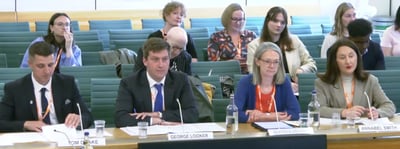
On 3 June 2026, Babyzone CEO George Looker gave oral evidence to the joint Work and Pensions and Education Committees as part of their inquiry, Realising Potential: Delivering the Child Poverty Strategy. George appeared on the first panel alongside representatives from Trussell, West of England Mayoral Combined Authority and EFL in the Community.
**Two legs to stand on**
George's core message to the Committee was clear: tackling child poverty requires two things working together. The income measures in the Strategy — scrapping the two-child limit and expanding free school meals — are welcome and will change lives. But cash alone is not enough.
"The second leg that we want to focus on today would be around infrastructure and ensuring that there is that high quality provision across the country, especially in very localised areas."
Babyzone works with more than 1,500 families every week across ten hubs in the UK, identifying need postcode by postcode to ensure support reaches those who need it most.
**What families are telling us**
The recurring theme George brought to the Committee was one of confidence and navigation. Families know they need help, but getting there is exhausting.
"The domain that we speak to parents in, time and time again, is a lack of confidence in terms of accessing the services they need and the support that they want. It's very fragmented for them and difficult to navigate."
Much of Babyzone's work is closing that loop — ensuring families are connected to support, not merely signposted to it. "It's never one thing that brings someone to this sort of level of crisis," George told the Committee. "Making sure that loop is closed, rather than just being handed over to another service, \[means\] families feel like they have to repeat the same challenge several times before they're heard."
**The case for quality**
On the rollout of Best Start Family Hubs, George was direct: quality is what brings families through the door, and it cannot be compromised as the programme scales.
"It needs to be barrierless, stigma-free environments that are warm and welcoming, that parents feel proud to go to with their children. That is a fundamental principle that we can't let be watered down."
He also raised the risk of growing disparity across the country, with some local authorities able to share health visitors, midwifery teams and infant feeding support and others unable to. "There's a lot of disparity across the country in terms of what's available for parents. Charities can do a lot of work on the front line to support local authorities and commissioning teams to ensure those gaps aren't there."
**Measuring what matters**
George urged the Committee not to focus solely on inputs. "I would caution around making sure that you look at both inputs, outputs and outcomes. We obsess about inputs, making sure we're serving the right level of families, but we also need to measure outcomes — things like parental confidence."
Critically, he argued that measurement must be tied to verified postcode data. "Our concern would be that you lose these things in the averages sometimes."
**Early intervention before crisis**
George pressed the value of reaching families before things break down, referencing a recent report on school readiness: children who are not school-ready at age four or five are nearly three times more likely to be NEET at 16 or 17, and deprivation multiplies that risk by a factor of eight.
"The clarity of the government's ambition in terms of investing early in the nought to five age range is fundamentally important."
**The role of charities**
George made a positive case for the voluntary sector — not as a stopgap, but as an active delivery partner. "Charities like ours have had to step into gaps where local infrastructure has been decimated. But we're able to be quite innovative and ambitious in a way that perhaps local services and government bodies aren't able to be. That enables us to be rapid in the way we can fill gaps, identify need, and share knowledge and best practice."
Babyzone works with over 300 organisations across its network. George called for sustained funding, genuine commissioning partnerships and the empowerment of organisations that families already trust.
**A united message across the session**
The two-hour session brought together witnesses from across the sector. Alongside George on the first panel were Beatrice Orchard from Trussell, Annabel Smith from West of England Mayoral Combined Authority and Tom Drake from EFL in the Community. The second panel featured Charis Chittick from One Parent Families Scotland, Josephine Whitaker-Yılmaz from Praxis and Lynn Perry MBE from Barnardo's.
Though witnesses approached the issue from different angles — income, housing, regional delivery, sport — the message was united: invest early, join things up locally, and trust the organisations families already turn to.
**Watch the session**
The full session is available to watch on [Parliament Live.](https://parliamentlive.tv/event/index/ff250262-9f49-413b-a9bb-2c1cc9146c12)
[Donate](https://babyzone.org.uk/donate)
[](https://babyzone.org.uk/)
Supporting families through early years with expert guidance, resources, and community connection. Every child deserves the best start in life.
[](https://www.fundraisingregulator.org.uk/directory/babyzone)
### Quick Links
- [About Us](https://babyzone.org.uk/about-us)
- [Our Team](https://babyzone.org.uk/team)
- [Hubs](https://babyzone.org.uk/visit-us)
- [Our Programmes](https://babyzone.org.uk/programmes)
- [Partners](https://babyzone.org.uk/partners)
- [Academy](https://babyzone.org.uk/academy)
- [Impact](https://babyzone.org.uk/research-impact)
- [Research](https://babyzone.org.uk/babyzone-research)
- [News & Media](https://babyzone.org.uk/blogzone)
- [Baby Buddy](https://babyzone.org.uk/baby-buddy-old)
### Contact Us
hello@babyzone.org.uk
Scale Space, 58 Wood Lane, London, W12 7RZ
Babyzone is a registered charity in England and Wales (1198316) and in Scotland (SC054355)
### Sign up to our newsletter here
Get the latest Early Years News Roundup delivered to your inbox
[Early Years News Roundup](https://share-eu1.hsforms.com/1Vneg2jsPR5C3b2eBW289Jw2b57kc)
[Donate](https://babyzone.org.uk/donate)
© 2026 Babyzone. All rights reserved. Making a difference in early years development.
- [Safeguarding Policy](https://babyzone.org.uk/hubfs/Babyzone%20Safeguarding%20Policy%20England%20-%20Updated%20Sept%202026%20(no%20appendix%20c).docx)
- [Privacy Policy](https://babyzone.org.uk/privacy-policy)
- [Safer Recruitment Policy](https://babyzone.org.uk/hubfs/Babyzone%20Safer%20Recruitment%20Policy%20-%20Updated%20Sept%202026.docx)
- [Whistleblowing Policy](https://babyzone.org.uk/hubfs/Babyzone%20Whistleblowing%20Policy%20-%20Updated%20Sept%202026.docx)
```json
{
"@context" : "https://schema.org",
"@type" : "BlogPosting",
"author" : {
"@type" : "Person",
"name" : "Admin",
"url" : "https://babyzone.org.uk/blogzone/author/admin"
},
"dateModified" : "2026-06-08T15:13:55.819Z",
"datePublished" : "2026-06-02T08:15:23.000Z",
"headline" : "Babyzone CEO gives evidence to Parliament on the Child Poverty Strategy",
"image" : [ "https://babyzone.org.uk/hubfs/Committee.jpeg" ],
"mainEntityOfPage" : {
"@id" : "https://babyzone.org.uk/blogzone/best-beginnings-episode-10-best-beginnings-episode-10-what-will-quince-told-us-about-power-prevention-and-the-first-1001-days",
"@type" : "WebPage"
},
"publisher" : {
"@type" : "Organization",
"logo" : {
"@type" : "ImageObject",
"url" : "https://babyzone.org.uk/hubfs/Babyzone_PrimaryLogo_Colour_OnLight_RGB.png"
},
"name" : "Babyzone"
}
}
```